First-time buyers need to know how home prices and interest rates interact, which affects the other factors and other related information when planning a home purchase. Buying a home depends on a lot more factors than simply the price of the house.
Since most home purchases involve a down payment and a mortgage for the remainder, you should consider these two elements: the home price and mortgage interest rates. These two factors, in addition to affecting the total cost of the home you want, could also have an effect on the final decision you make about whether to buy that house or not. Our next step will be to examine the relationship between interest rates and house prices in relation to the total cost of ownership.
Why are Interest Rates Relevant to the Housing Market?
The interest rate reflects both the cost of debt for the borrower and the return on lending for the lender. In most cases, lenders require repayment of more than the borrowed amount because they lose the use of the money during the loan period. Interest is calculated based on the difference between the total repayment sum and the original loan amount.
Interest rates have an influence on housing markets since they dictate the cost of a loan to buy a house. This in turn influences the value of the property, i.e., the price.
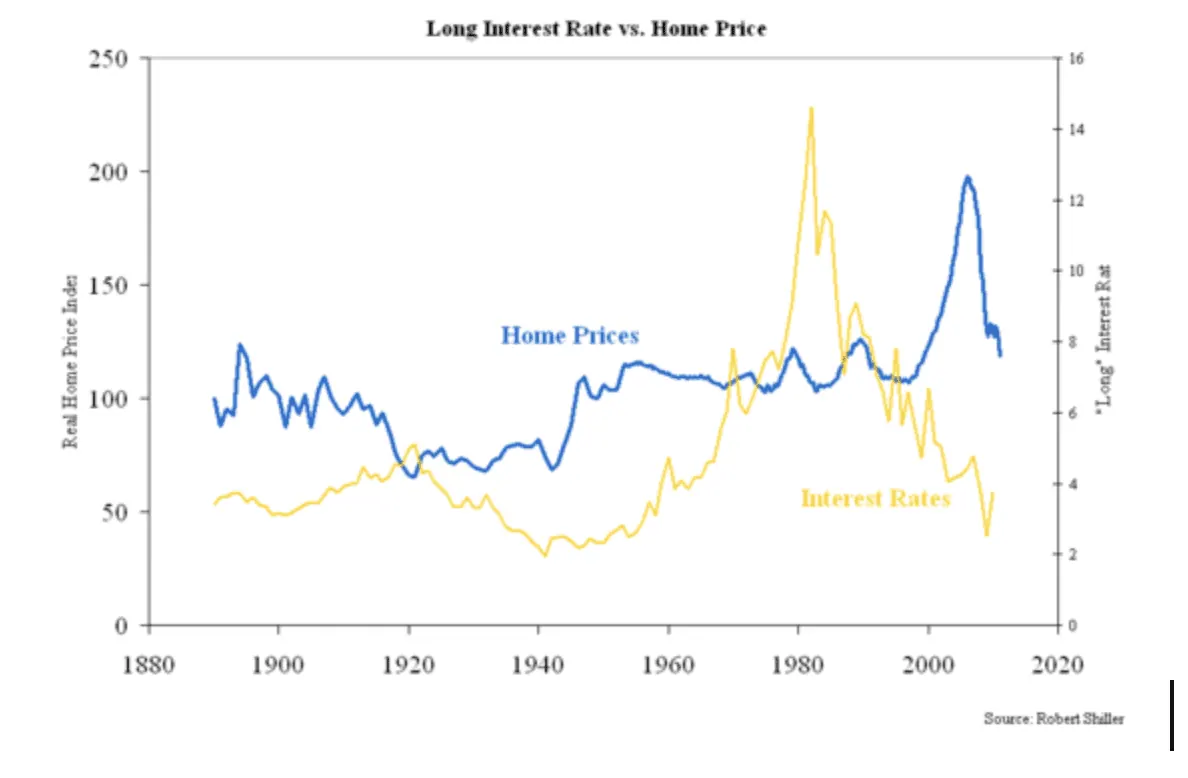
Do interest rates affect house prices
It is evident that interest rates impact real estate values in the derivation of discount or capitalization rates, which are equal to the risk-free rate plus a risk premium. However, the price of real estate directly depends on the mortgage rate at the time of sale. Mortgage calculators can be extremely useful for prospective homeowners or real estate investors researching interest rates.
Types of Mortgage Loans
Here are some basics about mortgage loans to understand how interest, mortgage rates, and home prices impact each other. Understanding these and what can affect the trend of interest and mortgage rates can help you in making decisions.
There are two primary forms of mortgage loans, fixed-rate and adjustable-rate. There are some other forms too, which are hybrids or derivatives. These forms have their own variations and rates of interest.
Fixed interest rate mortgages
As its name implies, this mortgage has a fixed interest rate and the mortgage rate stays the same throughout. This means, i.e., the same cost of payments for the duration of the mortgage.
Generally, 30-year fixed-rate mortgages are paid off in less than 30 years because the clients move or refinance. According to NAR (National Association of Realtors) Reports in 2022, most buyers expected to live in their homes for 12 years, down from 15 years last year. The expected duration for the silent generation and young millennials is 10 years, while up to 20 years for younger boomers.
Adjustable Rate Mortgages (ARM)
For this type of mortgage, the rate of interest could change monthly, e.g., six months, yearly, or less, depending on the mortgage terms. The rate of interest is composed of an index value and a margin called a fully-indexed interest rate. The resulting figure is rounded to one-eighth of a percentage point.
The margin is fixed for the mortgage lifetime while the index value is variable, thus tying the interest rate to an index. Various mortgage indices are used for different ARMs, using the interest rates of an actively traded financial security, a bank loan, or a bank deposit. However, all the indices are correlated. This means that all move the same way, upwards or downwards, depending on changes in economic conditions. Mortgage indices are mostly short-term indices. The “term” is the duration of the securities, loans, or deposits used in making the index. A security or loan or deposit that has a duration of one year or less is deemed short-term.
Hybrid Mortgages
Hybrid mortgages are a combination of both fixed-rate and adjustable-rate mortgage features. Initially, the rate is locked in for a specific number of years and later becomes adjustable. The advantage of this type of loan is the fixed-rate part gets lower mortgage rates than a 30-year interest-only one, which gives you lower monthly mortgage payments.
GOVERNMENT-INSURED LOAN
It should be noted that the US government is not a mortgage lender, but it does play an important role in making homeownership accessible and possible to its citizens. The government-backed mortgages are the FHA (Federal Housing Authority), VA (Veterans Administration) and USDA (U.S. Department of Agriculture). You will go through some added paperwork to the usual process of a regular mortgage. With a government-backed loan, people are provided with financial assistance that they would otherwise have.
Jumbo Loan
As the name suggests, Jumbo loans are big. They are beyond the limitations of the FHFA, the Federal Housing Finance Agency, a US regulatory agency overseeing the secondary mortgage market. Jumbo loans are more common in areas where home prices are beyond the conforming loan limits, like the high-cost areas of Los Angeles, San Francisco, New York City, and Hawaii.
Conventional Loans
A conventional loan is a loan that isn’t backed by the government and is available in two forms, conforming loans and non-conforming loans.
Conforming loans – are loan packages that comply (hence the name) with the FHFA standards, in terms of the borrower’s credit, debt size as well as the dimension of the loan. The current conforming loan limits (2022) for single-family homes are $647,200 generally and $970,800 in areas with higher costs.
Non-conforming loans – are loans that do not meet the standards of the FHFA. In general, non-conforming loans are usually taken by borrowers who have poor credit, or are struggling to repay their current loans, have been through major financial crises, such as bankruptcy, or are in the process of facing one.

How Interest Rates are Determined
The rates the banks charge for interest are regulated by several factors, like the economic situation. The central bank of a country sets the rate, which the banks use to set the range of annual percentage rates, APRs, they offer. A higher inflation rate causes central banks to raise the low-interest rate since the rising rate raises the debt cost, and the debt cost becomes a barrier to borrowing and slows consumer demand. Read more about Is It Better to Buy a House when Interest Rates are High?
Market and personal factors combined determine mortgage rates. The lender evaluates the cost of borrowing in the current state of the economy. The value that comes up is then based on monetary policy and the comprehensive economic condition. Additional considerations by the lender in determining your creditworthiness are your personal circumstances, e.g., your credit score, income, the size of the home you want to purchase, home prices, down payment, and your debt.
Factors that affect mortgage interest rates
Mortgage Points
The total mortgage cost is closely correlated to several factors, called “mortgage points.” In the mortgage process, you buy points, 1% of your loan amount, to swap for a reduction in the interest rate. It’s like paying a part of the interest on your loan in advance.
This concept works best for homeowners who intend to live in their homes for a longer time to recover their prepaid interest. Usually, these are borrowers on a long-term fixed-rate mortgage.
The mortgage points can also be used on adjustable-rate mortgages. When considering using mortgage points, discuss with your broker/real estate agent your plan for your home, like how long you plan to live in it – that is a key element in making the decision. Or, if you are selling your home before the loan’s maturity, it’s even possible that you have more points than you got with a reduced interest rate.
Cash payments
There are homeowners who do cash payments (from say a bonus or tax refund or higher wages) as an additional mortgage payment. This can reduce your loan’s term significantly and, in the long run, result in a lower interest rate! In the short term, you may experience a temporary setback. However, in the long run, you will be able to reduce your total interest by taking advantage of these opportunities.
Personal factors
Your income, credit score, and the type of house you want determine the rate your lender will offer you. Your credit score gives lenders an idea of your reliability to repay your loan. So candidates with a high credit score usually get more favorable interest rates than those with a poor credit score. In addition, a higher down payment on a home will show the lender you’re a low-level risk and would thus grant you lower mortgage rates.
Can I Buy a House with Low Mortgage Rates or Vice Versa?
The ideal time for a house purchase is determined by your financial capabilities and capacity and the other factors that influence mortgage rates. A low-interest rate can sometimes improve the affordability and manageability of mortgage payments.
Experts and real estate professionals always advise new or first-time homeowners to buy a home within their financial range of affordability. If you find a low-interest rate lender you could qualify for a mortgage on higher home prices but that doesn’t necessarily mean that’s the most advantageous choice you can make. Assess the proposed mortgage rate, then choose a home price you can afford based on current obligations.
Conclusion
Whether you’re looking to buy a house now or in the coming years, stay aware of the changes in home prices and interest rates. Include them as a factor when you consider the range of what you can afford. While it may not be wise to buy the more expensive house, you might be able to afford more than you expected. You may be able to save money to fix up an older home or perhaps buy brand-new construction.
Whether you’re planning to purchase a home now or later, keep yourself in the loop on not just house rates and home prices but interest rate changes, too. These are among the many factors to consider when you evaluate your purchasing power. The right thing for you to do is consult an expert real estate agent, Barry Jenkins of Legacy Home Team @ LPT Realty. You can call him directly at (757) 919-8874 or send him an email at barry@yourfriendlyagent.net to set an appointment. For other questions, inquiries, feel free to contact us.